Our Story
Born in the Mountains.
Built for the Bold.
How a mission to make Nepal's mountains safe became Himalayan Guardian.
The Story of Himalayan Guardian
Nepal opens its mountains to the world — but for years, it had no honest system to bring everyone home. Trekkers were stranded above the clouds. Rescues came late, or never. And a growing trade in fraudulent rescues preyed on the very emergencies it was meant to answer.
In 2019, during his tenure as CEO of the Nepal Tourism Board, Dr. Dhananjay Regmi set out to close that gap. What began as a vision grew through years of research, UNDP-backed guide training, a national GIS system built with Tribhuvan University, and rigorous field testing — culminating in the founding of Himalayan Guardian Nepal in Kathmandu in July 2025, and its Comprehensive Tourism Guard: insurance, GPS tracking, satellite communication, and rapid rescue, in one accountable system.
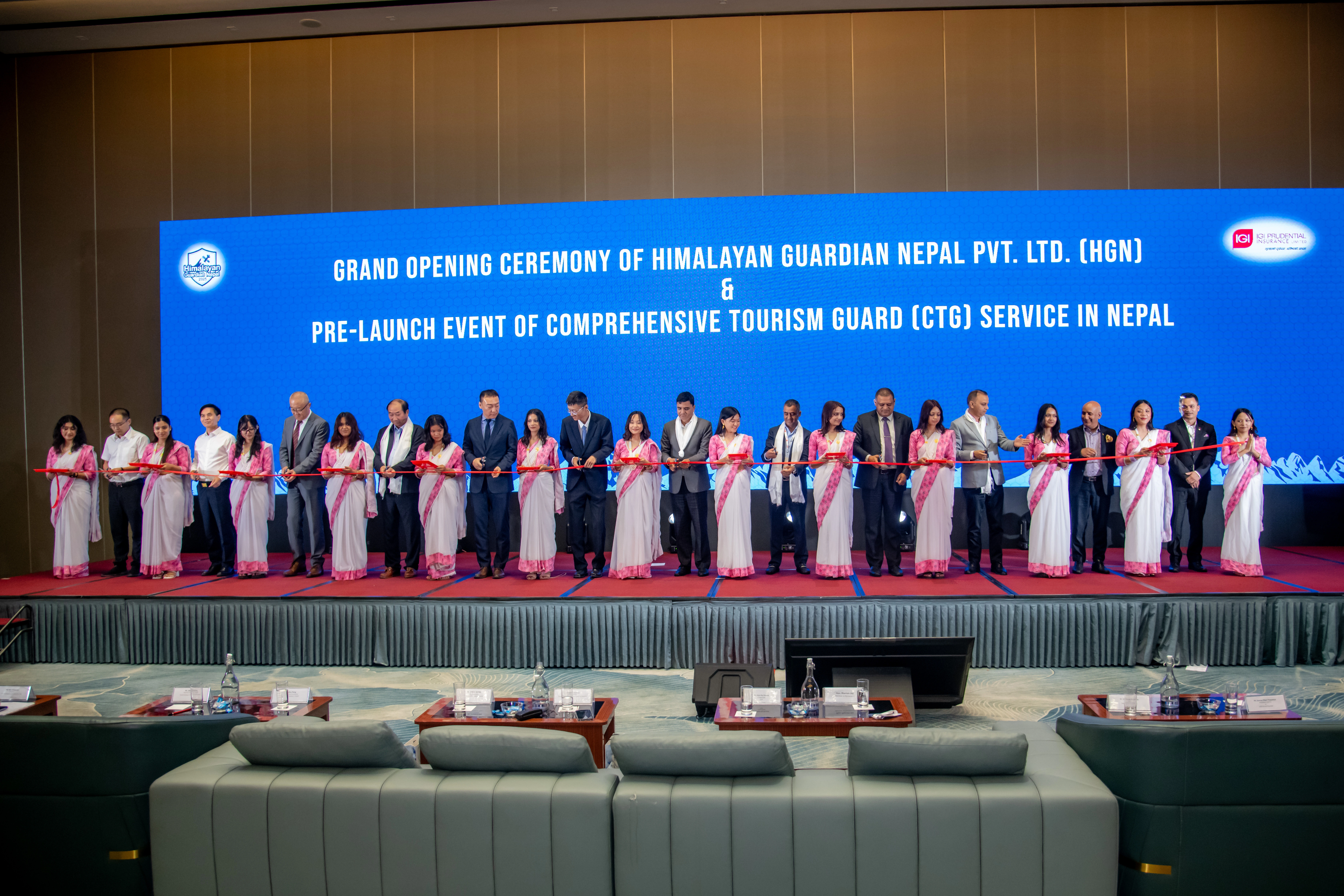
The grand opening of Himalayan Guardian Nepal.
The History of Himalayan Guardian
The Early Vision
The idea took shape at the Nepal Tourism Board, where the scale of the problem was impossible to ignore. With UNDP support, a nationwide program began equipping trekking guides and porters with the survival, emergency-response and tourist-safety skills the mountains demand — a foundation that would outlast any single rescue.
To make response scientific rather than improvised, a customised Geographic Information System was developed with Tribhuvan University, turning scattered field reports into real-time, geospatial intelligence for the people coordinating rescues.
Building the System
A framework is only as good as the tools that carry it. HGN customised and field-tested satellite GPS devices for real-time tracking, one-touch SOS and seamless rescue integration — hardware built for the mountains, not adapted for them.
Insurance was rebuilt to match: coverage designed around technology-enabled monitoring and rapid response, rather than paperwork filed after the fact. Together they became the Comprehensive Tourism Guard — one guard for every journey.
Backed by the Right Partners
Accountability is the difference between a promise and a guarantee. Himalayan Guardian is approved by the Nepal Telecommunications Authority and, through its partner IGI Prudential, by the Nepal Insurance Authority — with HGN as the sole distributor of these tailored products through CTG.
In October 2025, that system met its first true test: a client with severe Acute Mountain Sickness was rescued from Dzongla in the Everest region and delivered to hospital in thirty-three minutes. The accountability the mountains always deserved, proven on the mountain itself.
Miguel Díaz Vives on his experience with Himalayan Guardian.
In One Minute
How the Comprehensive Tourism Guard keeps every trekker connected, covered and rescued.
Year by Year: HGN History
Tourism Safety Concept Inception
During his tenure as CEO of the Nepal Tourism Board (NTB), Dr. Dhananjay Regmi identified critical challenges facing Nepal's tourism sector, particularly regarding tourist safety, reliability of rescue services, and the growing issue of fraudulent rescue practices. In response, he conceptualized a comprehensive tourism safety framework aimed at ensuring secure, reliable, and accountable tourism operations across the country.
Safety Program Implementation with UNDP Support
With financial and technical support from the United Nations Development Programme (UNDP), a nationwide safety training program was initiated. This program focused on capacitating trekking guides and porters with essential survival, emergency response, and tourist safety skills. The initiative was designed as a sustainable model under NTB to ensure standardized safety practices across Nepal's tourism workforce.
Development of Nepal Tourism GIS System
To strengthen real-time rescue and safety response mechanisms, a customized Geographic Information System (GIS) was developed in collaboration with Tribhuvan University under the guidance of Dr. Regmi. This system enhanced Nepal's tourism safety infrastructure by integrating scientific data and geospatial intelligence, significantly improving response time and decision-making capabilities.
Strategic Expansion Phase
Further conceptual development and stakeholder engagement were conducted to expand the tourism safety ecosystem into a scalable and technology-driven model.
April–November 2024
Market Assessment and Feasibility Study
A comprehensive market investigation was conducted to assess demand, operational feasibility, and potential scalability of integrated tourism safety and insurance services.
December 2024
Organizational Structuring
A dedicated team structure was established, including technical, operational, and administrative units to operationalize the concept into a functional enterprise.
February
Device Customization and Testing
Advanced safety devices were customized and rigorously tested to ensure real-time tracking, emergency alert functionality, and seamless integration with rescue systems.
May
Insurance Product Customization
Insurance packages were tailored to align with the tourism safety framework, integrating technology-enabled monitoring and emergency response features.
July 12
Company Establishment in Kathmandu
The enterprise was formally established in Kathmandu to operationalize tourism safety and insurance services.
July 15
Product Launch Event
Official launch of the integrated tourism safety solution, marking a major milestone in Nepal's tourism risk management sector.
August
Regulatory Approval — Nepal Telecommunications Authority (NTA)
HGN obtained official approval for device communication and connectivity compliance.
August
Regulatory Approval — Nepal Insurance Authority (NIA)
HGN's strategic partner IGI Prudential obtained official approval for tailored insurance products. An exclusive sales agreement between HGN and IGI Prudential authorizes HGN to be the sole distributor of these tailored insurance products by integrating them into the CTG service.
September 26
First Order Execution
Successful onboarding of the first client(s), demonstrating market acceptance and operational readiness.
October 24
First Rescue Case Completed
A client suffering from severe Acute Mountain Sickness (AMS) was rescued from Dzongla in the Everest Region (4,826 m) and transferred to Lukla, then admitted to a hospital — all within a total of 33 minutes. This highly efficient coordination and rapid response strongly demonstrate HGN’s professionalism.
March 4
Service Plan Upgrade
Enhanced service packages were introduced, incorporating user feedback, advanced features, and expanded coverage.
March
Upgrading of CTG Platform
Driven by insights from stakeholders, HGN launched Version 2.0 of its Comprehensive Tourism Guard Platform and website, significantly enhancing information sharing and cross-organizational collaboration.
March
Addressing Fake Rescue Incidents
With increasing concerns over fraudulent rescue operations in Nepal, this initiative positions HGN as a trusted, transparent, and technology-driven solution for tourism safety and emergency response.
Explore the Himalayas,
Guarded Every Step.
GPS tracking, insurance, and 24/7 rescue coordination in one plan. Get covered in minutes.